Search This Blog

Showing posts with label France. Show all posts

Friday, August 19, 2016

LAUTREC GRAFFITI

LAUTREC GRAFFITI


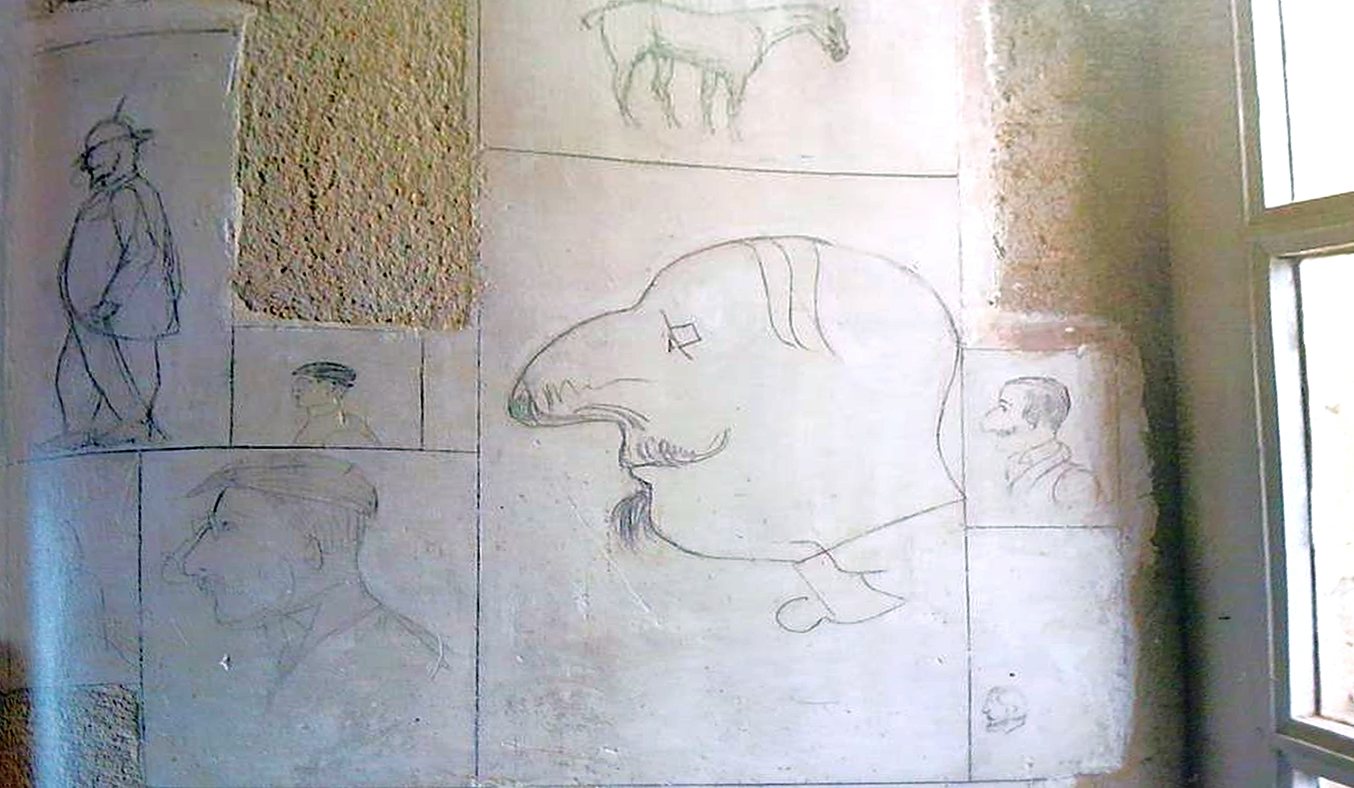
One of my passions over the last few years has been my cartooning and documenting the graffiti (I prefer to refer to it as free street or alley art) in my city. That having been said, it was only recently that I discovered that one of my favorite artists from the late 19th and early 20th centuries — Henri de Toulouse-Lautrec — was also a graffiti artist and cartoonist. Now, I have seen graffiti on buildings, in alleyways, in Montmartre that people will insist were done by Lautrec…but I think not. He did from time to time scrawl drawings or caricatures on the walls of various bistros and such (as did Utrillo), but no alley art has ever been documented. What there are however, are drawings done by a very young Toulouse-Lautrec on the walls of the orangery (a greenhouse where orange trees are grown) at the Château du Bosc dans l’ Aveyron, one of the family estates were the artist spent many vacations from early childhood right up until the time of his passing, portraying his early impressions of horses (a passion of his) and various relatives or people he knew as a child.

I have not been able to accurately date the following pencil sketches although I believe they, with the exception of one, predate his first tragic fall, breaking his left leg, on May 30, 1878. Already by the age of thirteen, Henri had shown a strong interest and a developing talent for drawing. My belief that these drawings predate 1878 is based on the fact that some of the sketches are located very high up on the walls, done no doubt with the assistance of a ladder — a height inaccessible to Lautrec for many years thereafter. Thus, they are perhaps among the earliest preserved Lautrec drawings.


The one drawing that I think is from a different time, done by an older Henri, is the last drawing in the series, of circus performers, no doubt done from memory, from a circus he may have visited with his mother some time later. Notice that the style is much more refined than the other graffiti in both style and detail.


(Photographs courtesy of Aoi Tokugawa)


Thursday, July 14, 2016

ABSINTHE MAKES THE HEART GROW FONDER: PART II, A VERY BRIEF HISTORY OF THE "GREEN MUSE"

ABSINTHE MAKES THE HEART GROW FONDER
PART II: A Very Brief History of "The Green Muse"

The Absinthe Drinker, by Viktor Oliva (1901).

The origins of “La Muse Virte” (“The Green Muse”) is somewhat unclear but it is known that she has been around for a very long time, and that wormwood (Artemisia absinthium) was used medicinally in ancient Egypt and was mentioned in the Ebers Papyrus dated c. 1550 BC. We also know that various wormwood extracts and leaves soaked in wine were also used as medicine by the ancient Greeks; however, the Greeks, ever the innovators, took things a step further and concocted a wormwood-flavored wine, absinthites oinos, perhaps a precursor of the Greek aperitif ouzo.

Dr. Ordinaire, c. 1792.

That having been said, the first evidence that we have of a “modern” absinthe, that is a distilled spirit containing green anise and fennel, only dates back to the 18th century where according to legend, “La Muse” made her debut as an “all purpose” patent medicine created by one Dr. Pierre Ordinaire[1], residing in Couvet, Switzerland somewhere around 1792. Ordinaire’s formula was passed on to the Henriod sisters,[2] also of Couvet, who then sold absinthe as a “medicinal elixir” (there are some however, who say that the Henriods were actually purveying their “elixir” long before Ordinaire ever arrived from France. Be that as it may, the next significant producer of absinthe was a Major Dubied who acquired the formula from the Sisters Henriod (we don’t know if he bought it or stole it), and who along with his son Marcellin and son-in-law Henry-Louis Pernod,[3] opened the first absinthe distillery, Dubied Pére et Fils, in 1797, again in Couvet, thus making the town the absinthe capital of the world at the time. In 1805, they built a second distillery in Pontarlier, France under the company name Maison Pernod Fils, which remained the most popular brand of “La Muse” until 1914.

Henry-Louis Pernod


Absinthe rose in popularity, particularly in France, during the 1840s, when it was given to (happy) French troops as a preventative medicine for malaria. Needless to say, when the troops returned home, they brought with them their fondness for the drink, which was spread to bars, bistros, cafés, and cabarets, so that by the 1860s, 5 p.m. was known as “l’heure verte” (“the green hour”), and the concoction became a cross-class favorite, pleasing the wealthy bourgeoisie, poor artists and writers, and the working-class. It has been said that absinthe was so popular that for many, their day started with a glass of absinthe and ended or perhaps restarted with the “l’heure verte” It may well have been that a blight on French vineyards in the 1870s was at least partly responsible for the spread of absinthe. At that time, wine was often drunk with water, because water in many places, such as Paris, had a high bacterial content and wine was believed to help alleviate the danger. When the phylloxera blight caused a spike in the prices of wine, the working classes (especially) turned to the cheaper absinthe to “purify” their water. Be that as it may, popularity by the 1880s resulted in mass production which in turn caused a dramatic price drop. Reports are that by 1910, the French alone were drinking 36 million liters of absinthe per year, as opposed to only 5 billion liters of wine per year!


Absinthe was widely exported and was somewhat popular in Spain, Portugal, Great Britain, the United States, and the Czech Republic. Sales of absinthe hit a spike in popularity during the early 20th century at a time when Art Nouveau and modernism were popular movements. In America, New Orleans had its own association with absinthe, noted as the birthplace of the “Sazerac” – perhaps the earliest absinthe cocktail. The Old Absinthe House bar, located on Bourbon Street, is a prominent historical landmark within the city. Originally named The Absinthe Room, it opened in 1874 and was frequented by such people as Mark Twain, Oscar Wilde, Franklin Roosevelt and even Frank Sinatra.


But alas, the temperance movement would eventually take hold in the U.S. and elsewhere, assisted by various winemakers’ associations, and “The Green Muse” found herself accused of all sorts of violent crimes and social disorder.
As one critic of absinthe complained, “Absinthe makes you crazy and criminal, provokes epilepsy and tuberculosis, and has killed thousands of French people. It makes a ferocious beast of a man, a martyr of women, and a degenerate of the infant. It disorganizes and ruins the family and menaces the future of the country.


Manet’s Le Buveur d’absinthe (1859) and Degas’ 1876 painting, L’Absinthe were at the time held up as the epitomic image of absinthe drinkers as addicted or doped. Émile Zola mentioned absinthe once but extensively described its effects in his novel L’Assommoir.

Le Buveur d’absinthe by Manet (1859). 

In 1905, it was widely reported that Jean Lanfray, a Swiss farmer, murdered his family and attempted suicide after drinking absinthe. The fact of the matter was that Lanfray was an acute alcoholic who had consumed copious amounts of wine and brandy before drinking two glasses of absinthe (a small fact conveniently overlooked in the press). The homicides were used as a rallying point for the hot topic of absinthe and resulted in a petition to ban absinthe in its own homeland of Switzerland. On July 5, 1908 the ban was approved and subsequently written into the Swiss constitution. Two years prior to that, Belgium and Brazil had banned absinthe, the Netherlands banned it in 1909, and the United States in 1912. Interestingly it was never banned in the United Kingdom
The ban in France led to the popularity of pastis, an anise-flavored aperitif and to a lesser degree, Greek ouzo. Following World War I, production of the Pernod Fils brand of absinthe was renewed in Catalonia, Spain where it had never been banned; however, sales were slight and production ceased in the 1960s, while in Switzerland, absinthe went “underground,” produced in secret home distilleries in a colorless form, la Bleue, which was easier to conceal from the law.

Next time: The manufacture and "mixology" of "The Green Muse."


[1] Dr. Pierre Ordinaire, a French doctor living in Switzerland had no sinister intent; rather, his intention was to deliver to people the extract wormwood, which had long been known to have powerful healing effects -- in a handy form.
[2] The Sisters Henriod had for a very long while been creating medicinal tinctures and tisanes to help the residents of Couvet, Switzerland. Many of their recipes had been passed down to them from their mother and her mother before.  Although the Sisters were well respected and their shop well patronized, they still needed to be cautious of the ever possible accusation of witchcraft even then; for even though the final Witchcraft Act of 1735 written into law led to prosecution for fraud rather than pacts with the Devil, both could result in in a death sentence. (This same act was still used in Switzerland during the 1940s to prosecute spiritualists and Gypsies and it wasn’t repealed until 1951.)
Now, according to the sisters' descendants, the two ladies were very clever but also knew their limitations by virtue of simply being women in the 1790s; therefore, they secured the help of their friend, DR. Pierre Ordinaire, who they claim had quite a fancy for their mother, to promote their wormwood product - Absinthe -and he was quite successful at it. One might say he was a natural salesman, who attracted the attention of French businessman, Major Dubied, who ultimately purchased the recipe from the sisters at a very tidy sum.

[3] The story of Pernod began in 1805. Born in Switzerland in 1776, Henri-Louis Pernod founded his distillery in the town of Pontarlier, located in the region of Doubs in eastern France, “La Maison Pernod Fils”. The company produced and marketed Absinthe Pernod Fils, a drink inspired by an elixir whose recipe Henri-Louis Pernod had acquired from its creator, Dr. Ordinaire (or possibly the Sisters Henriod).In 1926, “La Maison Pernod Fils” merged with “Distillerie Hémard”, founded in Montreuil in 1871 by Ariste Hémard, and “Pernod Père et Fils”, founded in Avignon in 1872 by Jules-François Pernod. These three companies came together to create “Établissements Pernod”. This organization was directed by Jean Hémard, the grandson of Ariste Hémard.
In 1959, “Établissements Pernod” became “Pernod SA”.

Tuesday, July 5, 2016

IRIS: HOKUSAI AND VAN GOGH

IRIS: HOSKUSAI AND VAN GOGH


     " My studio is not bad, especially as I have pinned a lot of little Japanese prints on the wall, which amuse me very much."

Iris and Grasshopper, from an unnamed series by Katsushika Hokusai, c. 1833.

Iris, Vincent van Gogh, Saint-Rem7-de-Provence, 1889.


Thursday, June 16, 2016

ABSINTHE MAKES THE HEART GROW FONDER: PART I

ABSINTHE MAKES THE HEART GROW FONDER: PART I


Ernest Hemingway, James Joyce, Charles Baudelaire, Paul Verlaine, Arthur Rimbaud, Henri de Toulouse-Lautrec, Amedeo Modigliani, Pablo Picasso, Vincent van Gogh, Oscar Wilde, Marcel Proust, Aleister Crowley, Erik Satie, Edgar Allan Poe, Lord Byron and Alfred Jarry all drank It has been talked about, written about, sung about, written about, and the subject of paintings and posters.

L'Absinthe, by Edgar Degas (1876)

 Simply put, absinthe is historically described as a distilled, highly alcoholic (90–148 U.S. proof) spirit, anise-flavoured derived from botanicals, including the flowers and leaves of Artemisia absinthium ("grand wormwood"), together with green anise, sweet fennel, and other medicinal and culinary herbs. It traditionally has a natural green colour but may also be colourless. In literature and common usage during the 19th and early 20th centuries, it was referred to as "la fée verte" ("the green fairy"). Although it is sometimes mistakenly referred to as a liqueur, absinthe is not traditionally bottled with added sugar; it is therefore classified as a spirit, traditionally bottled at a high level of alcohol by volume, normally diluted with water prior to being consumed by all but the die-hards imbibers.

Green Muse by Albert Maignan (1895)

Absinthe originated in the canton of Neuchâtel in Switzerland in the late 18th century. It rose to great popularity as an alcoholic drink in late 19th- and early 20th-century France, particularly among Parisian artists and writers. Owing in part to its association with bohemian culture, the consumption of absinthe was opposed by social conservatives and prohibitionists.

By Henri Privat-Livermont (1896)

Absinthe has often been portrayed as a dangerously addictive psychoactive drug and hallucinogen by the righteous and self-righteous. The chemical compound thujone, although present in the spirit in only trace amounts, was blamed for its alleged harmful effects. By 1915, absinthe had been banned in the United States and in much of Europe, including France, the Netherlands, Belgium, Switzerland and Austria-Hungary. Although absinthe was vilified, it has not been demonstrated to be any more dangerous than ordinary spirits. Recent studies have shown that absinthe's psychoactive properties (apart from that of the alcohol) have been exaggerated. A revival of absinthe began in the 1990s, following the adoption of modern European Union food and beverage laws that removed longstanding barriers to its production and sale. By the early 21st century, nearly 200 brands of absinthe were being produced in a dozen countries, most notably in France, Switzerland, Australia, Spain, and the Czech Republic. Not so much in the United States, as I shall explain…

In 2007, the Alcohol and Tobacco Tax and Trade Bureau (TTB) effectively lifted the long-standing absinthe ban, and  has approved many brands for sale in the US market. This was made possible partly through the TTB's clarification of the Food and Drug Administration's  thujone content regulations, which specify that finished food and beverages that contain Artemisia species must be thujone-free; thus, the TTB considers a product thujone-free if the thujone content is less than 10 ppm. The import, distribution, and sale of absinthe is permitted subject to the following restrictions:
The product must be thujone-free as per TTB guidelines,
The word "absinthe" can neither be the brand name nor stand alone on the label, and
The packaging cannot "project images of hallucinogenic, psychotropic, or mind-altering effects."
Absinthe imported in violation of these regulations is subject to seizure at the discretion of U.S. Customs and Border Protection.


More, including the early history and lore of absinthe next time.


Sunday, April 17, 2016

A VERY BRIEF HISTORY OF THE SALON DE PARIS


The Salon (or more formally the Salon de Paris), with roots extending as far back as 1667, was the official exhibition of art by the Académie des Baux-Arts. In the years between 1748 and 1890 the Salon de Paris without doubt, staged the greatest art events held in the western world. In 1667, the Académie Royale de Peinture et de Sculpture, part of the Académie des Baux-Arts, held its first art exhibition at the Salon Carré, with its focus on the works of recent graduates of the École des Baux-Arts. In short order, to have one’s work shown at the Salon de Paris was considered vital in order for any artist to achieve even a modicum of success in France and it remained so for the next two hundred years.

Salon de Louvre, 1737.

In the year 1725, the Salon was held in the Palace of the Louvre and received its name, Salon or Salon de Paris. While up until that time exhibitions had been regarded only as more or less private, beginning with the 1737 exhibition in the Grand Salon, they indeed became fully public (within limitations), and were held annually; and later, biennially in odd-numbered years. Beginning in 1748, the task of judging the exhibitions was given to a jury of award-wining artists, thus establishing the Salon’s preeminence over French art.

Honoré Daumier 'Free day at the Salon' From the series "Le
Public du Salon," published in Le Charivari (May 17, 1852)

By modern standards, the exhibitions of art at the Salon were what could well be termed, “chaotic magnificence,” with paintings hung floor-to-ceiling, utilizing every inch of space possible — far removed from today’s orderly, moderated gallery exhibitions. At the same time, for good or bad, critical accounts of the exhibitions were published in the local newspapers and journals, giving birth to the (still) dreaded art critic.

 
The Salon, 1865

The Salon, 1866

While attendance to the earlier, royal-sanctioned art exhibits had been limited to the aristocracy and “upper-classes” and exhibitors limited solely to French artists, the French revolution, in keeping with the motto of “Liberté, égalité, fraternité,” opened the exhibitions up to not only foreign artists as well as French, but to the public, or at least to those who could afford tickets; and opening night became a grand social event. After the 1848 revolution, the number of refused works grew less and less and the practice of awarding medals was instituted.
As time passed however, the Salon jurors became increasingly conservative and as Impressionism began to gain in prominence in some art circles, Impressionist artists found themselves either rejected with increased frequency or that at the very least, their works were placed in obscure locations — all because their style was a decided turn away from accepted, traditional painting styles. An unusually high number of submissions were turned away in 1863, resulting in a furor which included artists who had up to that time been regular exhibitors but found themselves excluded. In response, as though somehow to prove that the Salons were in fact “democratic,” Napoleon III began the Salon des Refusés, literally the “exhibition of rejects,” which opened in May of 1863, simultaneously marking the advent of the avant-garde. Ultimately, the Impressionists held their own series of independent expositions in 1874, 1876, 1877, 1880 – 1882, and in 1886. The French government however, which had historically sponsored the annual Salon exhibitions, withdrew its sponsorship, with the Société des Artistes Francais, stepping in.

The Salon, 1890.

In 1890, the Société suggested to the French art community that the Salon should be limited to an exhibition by young artists who had not previously won awards. This idea went over like a lead Montgolfier balloon, particularly with such “senior” artists as Auguste Rodin and his colleagues, who then broke away to form their own Société Nationale des Beaux-Arts, and it was the Société that began its own exhibition, the Salon du Chap de Mars or more properly the Salon de la Société Nationale des Beaux-Arts, chaired by Théophile Gautier. Dissatisfaction continued on into the next century when in 1903 a group of artists led by Pierre-Auguste Renoir, Henri Matisse and Auguste Rodin formed the Salon d’Automne (Autumn Salon), which became the showcase for development and art innovation in the early 20th century, further establishing the eminence of Rodin, Renoir, Cezanne, and Gaugin among others.

The Salon, 1932.