Search This Blog

Showing posts with label Montmartre. Show all posts

Thursday, June 16, 2016

ABSINTHE MAKES THE HEART GROW FONDER: PART I

ABSINTHE MAKES THE HEART GROW FONDER: PART I


Ernest Hemingway, James Joyce, Charles Baudelaire, Paul Verlaine, Arthur Rimbaud, Henri de Toulouse-Lautrec, Amedeo Modigliani, Pablo Picasso, Vincent van Gogh, Oscar Wilde, Marcel Proust, Aleister Crowley, Erik Satie, Edgar Allan Poe, Lord Byron and Alfred Jarry all drank It has been talked about, written about, sung about, written about, and the subject of paintings and posters.

L'Absinthe, by Edgar Degas (1876)

 Simply put, absinthe is historically described as a distilled, highly alcoholic (90–148 U.S. proof) spirit, anise-flavoured derived from botanicals, including the flowers and leaves of Artemisia absinthium ("grand wormwood"), together with green anise, sweet fennel, and other medicinal and culinary herbs. It traditionally has a natural green colour but may also be colourless. In literature and common usage during the 19th and early 20th centuries, it was referred to as "la fée verte" ("the green fairy"). Although it is sometimes mistakenly referred to as a liqueur, absinthe is not traditionally bottled with added sugar; it is therefore classified as a spirit, traditionally bottled at a high level of alcohol by volume, normally diluted with water prior to being consumed by all but the die-hards imbibers.

Green Muse by Albert Maignan (1895)

Absinthe originated in the canton of Neuchâtel in Switzerland in the late 18th century. It rose to great popularity as an alcoholic drink in late 19th- and early 20th-century France, particularly among Parisian artists and writers. Owing in part to its association with bohemian culture, the consumption of absinthe was opposed by social conservatives and prohibitionists.

By Henri Privat-Livermont (1896)

Absinthe has often been portrayed as a dangerously addictive psychoactive drug and hallucinogen by the righteous and self-righteous. The chemical compound thujone, although present in the spirit in only trace amounts, was blamed for its alleged harmful effects. By 1915, absinthe had been banned in the United States and in much of Europe, including France, the Netherlands, Belgium, Switzerland and Austria-Hungary. Although absinthe was vilified, it has not been demonstrated to be any more dangerous than ordinary spirits. Recent studies have shown that absinthe's psychoactive properties (apart from that of the alcohol) have been exaggerated. A revival of absinthe began in the 1990s, following the adoption of modern European Union food and beverage laws that removed longstanding barriers to its production and sale. By the early 21st century, nearly 200 brands of absinthe were being produced in a dozen countries, most notably in France, Switzerland, Australia, Spain, and the Czech Republic. Not so much in the United States, as I shall explain…

In 2007, the Alcohol and Tobacco Tax and Trade Bureau (TTB) effectively lifted the long-standing absinthe ban, and  has approved many brands for sale in the US market. This was made possible partly through the TTB's clarification of the Food and Drug Administration's  thujone content regulations, which specify that finished food and beverages that contain Artemisia species must be thujone-free; thus, the TTB considers a product thujone-free if the thujone content is less than 10 ppm. The import, distribution, and sale of absinthe is permitted subject to the following restrictions:
The product must be thujone-free as per TTB guidelines,
The word "absinthe" can neither be the brand name nor stand alone on the label, and
The packaging cannot "project images of hallucinogenic, psychotropic, or mind-altering effects."
Absinthe imported in violation of these regulations is subject to seizure at the discretion of U.S. Customs and Border Protection.


More, including the early history and lore of absinthe next time.


Friday, June 10, 2016

THE LORETTES OF MONTMARTRE


THE LORETTES OF MONTMARTRE

Montmartre by Hippolyte Bayard Molinos, c. 1842


By the late 1700s, Montmartre, located just outside the city limits of Paris and separated from the city by the Wall of the Fermiers-Généraux, was in effect a town unto itself, located on and around a high butte, the landscape dotted with small farms, vineyards, windmills, and ramshackled homes, a fact made official in 1790 when the National Constituent Assembly designated it as the Commune of Montmartre with its own town hall, Georges Clemenceau[1] as its mayor, and its own industries: wine making, stone quarries and gypsum mines. Under the Haussmanization[2] (urban renewal) of Paris at the behest of Emperor Napoleon III, the wall was torn down and January 1, 1860, it was annexed to the city along with other communities (faubourgs) surrounding Paris, and became part of the 18th arrondissement of Paris.[3] There was Montmartre extra muros or High Montmartre, high up and on top of the butte, and then there was Montmartre intra muros or “Low Montmartre), as one might expect on the lower slope and at the bottom.
Now, the population at the time, in High Montmartre was what one might consider rather rustic and generally friendly, made up of millers, vine-growers, laborers and men who worked the quarries. Montmartre intra muros however was far different — a tempestuous conglomeration of taverns and cabarets and their proprietors, various and assorted ruffians, and the denizens of dance halls and guinguettes; that is; taverns with gardens where one could dance and drink to their heart’s content (a tradition that extended as far back as 1640). Guinguettes also served as restaurants. The origin of the term comes from guinguet, meaning a nasty sour white light local wine that was served in such establishments in the old days. The 1750 Dictionnaire de la langue français, defined guinguette as a “small cabaret in the suburbs and the surrounds of Paris, where craftsmen drink in the summer and on Sundays and on Festival days”; however, this definition would seem to have been concocted by the local chambre du commerce. Once the wall was down, the journey up the butte to High Montmartre became an easier trek for the Low Montmartrois. The rogues and harlots headed uphill and with that also began the migration of the lorettes.

Terrace of a Cafe on Montmartre (La Guinguette) by Van Gogh (1886)

Luncheon of a Boating Party, Dejeuner de Canotiers by Renoir (1880 - 1881) 

Lorettes” sounds like it could have been a Motown singing group from the late 1950s or 1960s but really what “lorettes” meant, was “kept women;” “respectable mistresses,” who to some occupied a theoretical “middle ground” of prostitution between the grande dame of commercial sex, the courtesan, and the far more “gritty” street prostitute, who occupied Low Montmartre. Actually they came from the Notre-Dame-de-Lorette neighborhood (thus the name); originally a band of noisy, vulgar women whose antics often made the bourgeoisie blush, giving Montmartre what can only be regarded as a thoroughly scandalous reputation, beyond what it had already achieved. Later the lorettes would assume at least some of the trappings of refinement if not the culture itself.
They might have been described as neither wives nor spinsters, and according to them, neither were they prostitutes. Probably the daughters of tradesmen and Artisans in Notre-Dame-de-Lorette, they were most often not more than girls, or at least young women, who had struck out on their own to live among the artists and bohemians of Montmartre and they were not, it seems, totally unwelcome; for, the owners of newly constructed apartments or hotels often let the girls live there free until such time as the rooms could be rented. As things progressed, they were most often elegantly attired and “entertained” their men (frequently upper class bourgeoisie or lower-level aristocrats — business men, professionals or even wealthy students), often in well decorated apartments, or at least accompanied them out, —. In this way, they dwelled on the very edge between respectability and social stigma. In the course of events, they lived with their men, deserted them (or were themselves deserted) — then moved on to the next. And when the great adventure was over, they frequently went back to their families (thus the “migration”) or drifted downward to wretchedness and despair; often ending up in the hospital as victims of venereal diseases, or worse, floating in the Seine.
Van Gogh knew them, Lautrec knew them, Degas knew them, Balzac wrote about them in Grandeurs et miséres des courtisanes, and Gavarni,[4] Guys,[5] and others painted them.

Les  Lorettes, from a series (c. 1841)

Lorettes by Gavarni (no date available)

Two Lorettes at the Theater by Constantine Guys, (no date available)

Loge by Constantin Guys (no date available)


[1] Georges Benjamin Clemenceau (September 28, 1841 – November 24, 1929) was a French statesman who led the nation in the First World War. A leader of the Radical Party, he played a central role in politics during the Third Republic. Clemenceau served as the Prime Minister of France from 1906 to 1909, and again from 1917 to 1920. In favor of a total victory over the German Empire, he militated for the restitution of Alsace-Lorraine to France. He was one of the principal architects of the Treaty of Versailles at the France Peace Conference of 1919. Nicknamed “Père la Victoire” (Father Victory) or “Le Tigre” (The Tiger), he took a harsh position against defeated Germany, though not quite as much as the President Raymond Poincaré, and won agreement on Germany's payment of large sums for reparations.
[2] Haussmann’s renovation of Paris was a vast public works program commissioned by Emperor Napoléon III and directed by his prefect of the Seine, Georges-Eugène Haussmann, between 1853 and 1870. It included the demolition of crowded and unhealthy medieval neighborhoods, the building of wide avenues, parks and squares, the annexation of the suburbs surrounding Paris, and the construction of new sewers, fountains and aqueducts. Haussmann's work met with fierce opposition, and he was finally dismissed by Napoleon III in 1870; but work on his projects continued until 1927. The street plan and distinctive appearance of the center of Paris today is largely the result of Haussmann's renovation.
[3] The city of Paris is divided into twenty arrondissements municipaux, administrative districts, more simply referred to as arrondissements. These are not to be confused with departmental arrondissements, which subdivide the 101 French départements. The word "arrondissement", when applied to Paris, refers almost always to the municipal arrondissements.
[4] Paul Gavarni was the nom de plume of Sulpice Guillaume Chevalier (January 13, 1804, Paris – November 24 1866), a French illustrator, born in Paris.
[5] Constantin Guys, Ernest-Adolphe-Hyacinthe-Constantin, (December 3, 1802 – December 13, 1892) was a Dutch-born Crimean War correspondent, water color painter and illustrator for British and French newspapers.

Friday, June 3, 2016

MONTMARTRE

MONTMARTRE

Way back when I was a small boy, a 5th grader as I recall, my mother decided that it was time for me to be exposed to the arts rather than just the games that boys play; thus music lessons were in order as well as a change of bedroom décor – from model airplanes to famous paintings. In actuality, the model airplanes remained, only suspended in “flight” from the ceiling. There were two walls that she had to “play” with, the other two being occupied by a large picture window and a big, walk-in closet. One day she made a trip down to the Tro Harper bookstore on Powell Street (San Franciscans from my generation might remember that wonderful place) and returned with what she was certain were real treasures (albeit inexpensive). On one wall, she hung large, framed prints by Maurice Utrillo and on the other, framed prints by Vincent Van Gogh. Now these weren’t just the paper prints we commonly see today, but prints mounted on heavy, textured cardboard so as to give texture to the prints, as though they actually were paintings. And for years afterward, until I left at age eighteen, they hung there, and I looked at them, and wondered, and dreamed.
There was Utrillo’s 1938 Montmartre,


his 1937 Lapin Agile,


his 1934 Sacre-Coeur de Montmartre and Passage Cottin,


and lastly his 1914 Street in Paris.


To the right of those, on the next wall was my Van Gogh “collection”: Wheat Field and Cypresses (1889),


Starry Night (1889),


Café Terrace at Night (1888),


Irises (1889),


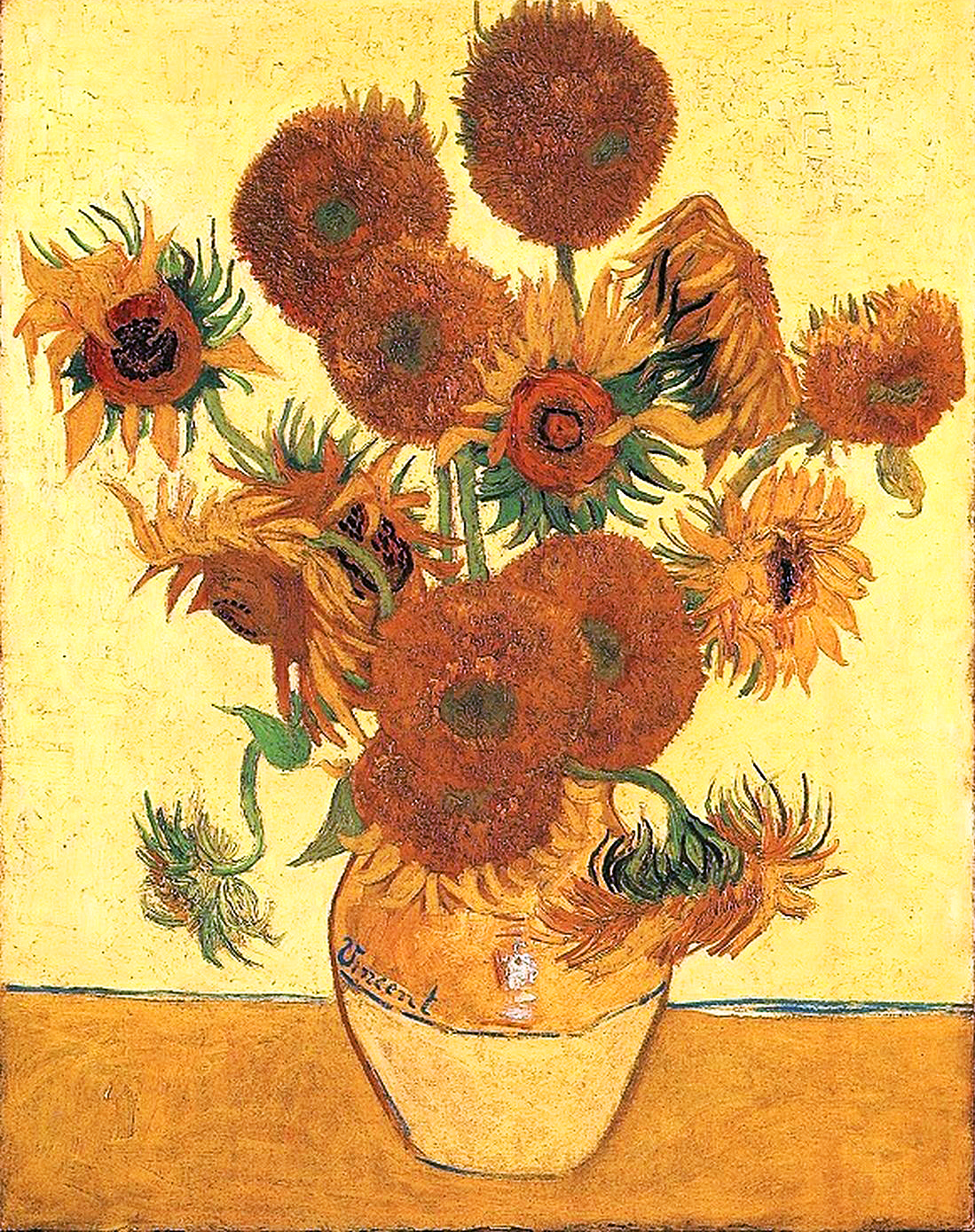
and just for good measure, upstairs, over the fireplace was Vase with Fifteen Sunflowers (1888).


Irises I wasn’t so excited about. What young boy really is; however, especially in summer, I used to look at Wheat Field and could easily imagine being right there — I could smell the wheat and the cypresses carried on a warm breeze. I used to imagine myself at one of the tables in Café Terrace at Night, on the Place du Forum in Arles, just watching the world go by. And Starry Night I could look at for hours — as though in a dream courtesy of Vincent. I found myself wanting to go to the Lapin Agile of Utrillo’s painting, and wanted to go inside, even though I had no idea what a lapin agile was or what the actual place was. I could imagine people walking past the wine and liquor store in his Montmartre, wondered what the church at the top of the butte in Sacre-Coeur de Montmartre was like inside, and wished I could go into the boulangerie in Street in Paris — I could almost smell the bread baking.
It was at about that same time that I became acquainted with Henri de Toulouse-Lautrec via John Houston’s 1952 production of Moulin Rouge with José Ferrer as Lautrec. What a marvelous movie; one in which Houston went to great lengths to match the appearance of actors and actresses with the characters of Lautrec’s Montmartre posters and paintings, not to mention the incredible detail paid to the interior shots of the cabarets and bars. His characters came alive and I was enthralled by their exoticism.


So one might say that in a sense I grew up in Montmartre, at least the Montmartre of the time of Van Gogh, Utrillo, Degas, and so many other artists, as well as the Montmartre of the Chat Noir, the Moulin Galette, and the Moulin Rouge. Montmartre was art, it was music, and was home to so many famous and some notorious folk that stirred the imagination. I went there once. Some visitors to France prefer the Louvre, or Versailles, or the Riviera, but not I. Montmartre was art and life at its grittiest, even then. I could almost hear the ghosts; for it was both wonderful and ghostly all at once. Truth be told, if I were to live in Paris, I would most certainly have to live in Montmartre — no other place would do.
There is a lot more to Montmartre than the average person realizes in terms of its history, art, music, and people. I made the district a sort of hobby and have studied it off and on through the decades, and I hope over the next few weeks to share some of what I have learned about this wonderful, ghostly, sinister and strange place.