Search This Blog

Showing posts with label Lautrec. Show all posts

Friday, August 19, 2016

LAUTREC GRAFFITI

LAUTREC GRAFFITI


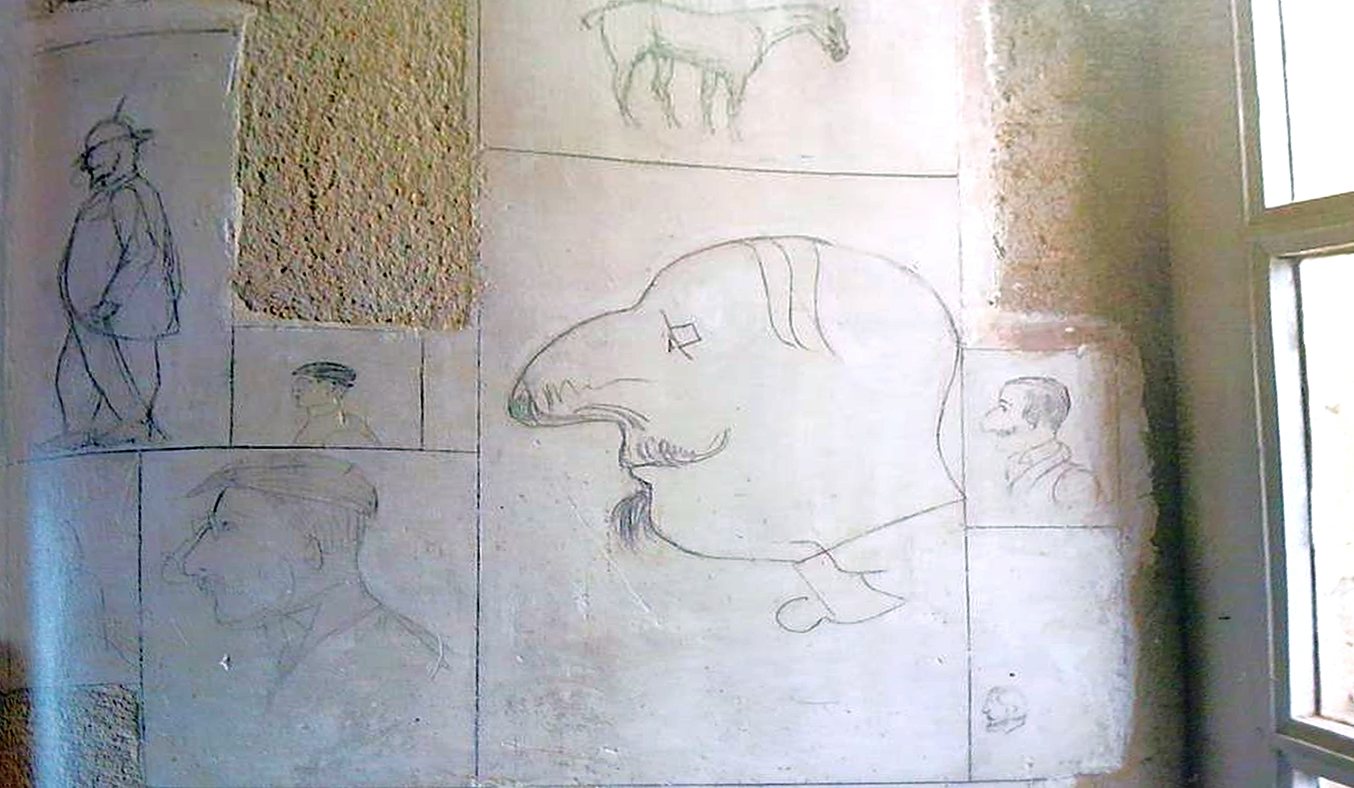
One of my passions over the last few years has been my cartooning and documenting the graffiti (I prefer to refer to it as free street or alley art) in my city. That having been said, it was only recently that I discovered that one of my favorite artists from the late 19th and early 20th centuries — Henri de Toulouse-Lautrec — was also a graffiti artist and cartoonist. Now, I have seen graffiti on buildings, in alleyways, in Montmartre that people will insist were done by Lautrec…but I think not. He did from time to time scrawl drawings or caricatures on the walls of various bistros and such (as did Utrillo), but no alley art has ever been documented. What there are however, are drawings done by a very young Toulouse-Lautrec on the walls of the orangery (a greenhouse where orange trees are grown) at the Château du Bosc dans l’ Aveyron, one of the family estates were the artist spent many vacations from early childhood right up until the time of his passing, portraying his early impressions of horses (a passion of his) and various relatives or people he knew as a child.

I have not been able to accurately date the following pencil sketches although I believe they, with the exception of one, predate his first tragic fall, breaking his left leg, on May 30, 1878. Already by the age of thirteen, Henri had shown a strong interest and a developing talent for drawing. My belief that these drawings predate 1878 is based on the fact that some of the sketches are located very high up on the walls, done no doubt with the assistance of a ladder — a height inaccessible to Lautrec for many years thereafter. Thus, they are perhaps among the earliest preserved Lautrec drawings.


The one drawing that I think is from a different time, done by an older Henri, is the last drawing in the series, of circus performers, no doubt done from memory, from a circus he may have visited with his mother some time later. Notice that the style is much more refined than the other graffiti in both style and detail.


(Photographs courtesy of Aoi Tokugawa)


Thursday, June 16, 2016

ABSINTHE MAKES THE HEART GROW FONDER: PART I

ABSINTHE MAKES THE HEART GROW FONDER: PART I


Ernest Hemingway, James Joyce, Charles Baudelaire, Paul Verlaine, Arthur Rimbaud, Henri de Toulouse-Lautrec, Amedeo Modigliani, Pablo Picasso, Vincent van Gogh, Oscar Wilde, Marcel Proust, Aleister Crowley, Erik Satie, Edgar Allan Poe, Lord Byron and Alfred Jarry all drank It has been talked about, written about, sung about, written about, and the subject of paintings and posters.

L'Absinthe, by Edgar Degas (1876)

 Simply put, absinthe is historically described as a distilled, highly alcoholic (90–148 U.S. proof) spirit, anise-flavoured derived from botanicals, including the flowers and leaves of Artemisia absinthium ("grand wormwood"), together with green anise, sweet fennel, and other medicinal and culinary herbs. It traditionally has a natural green colour but may also be colourless. In literature and common usage during the 19th and early 20th centuries, it was referred to as "la fée verte" ("the green fairy"). Although it is sometimes mistakenly referred to as a liqueur, absinthe is not traditionally bottled with added sugar; it is therefore classified as a spirit, traditionally bottled at a high level of alcohol by volume, normally diluted with water prior to being consumed by all but the die-hards imbibers.

Green Muse by Albert Maignan (1895)

Absinthe originated in the canton of Neuchâtel in Switzerland in the late 18th century. It rose to great popularity as an alcoholic drink in late 19th- and early 20th-century France, particularly among Parisian artists and writers. Owing in part to its association with bohemian culture, the consumption of absinthe was opposed by social conservatives and prohibitionists.

By Henri Privat-Livermont (1896)

Absinthe has often been portrayed as a dangerously addictive psychoactive drug and hallucinogen by the righteous and self-righteous. The chemical compound thujone, although present in the spirit in only trace amounts, was blamed for its alleged harmful effects. By 1915, absinthe had been banned in the United States and in much of Europe, including France, the Netherlands, Belgium, Switzerland and Austria-Hungary. Although absinthe was vilified, it has not been demonstrated to be any more dangerous than ordinary spirits. Recent studies have shown that absinthe's psychoactive properties (apart from that of the alcohol) have been exaggerated. A revival of absinthe began in the 1990s, following the adoption of modern European Union food and beverage laws that removed longstanding barriers to its production and sale. By the early 21st century, nearly 200 brands of absinthe were being produced in a dozen countries, most notably in France, Switzerland, Australia, Spain, and the Czech Republic. Not so much in the United States, as I shall explain…

In 2007, the Alcohol and Tobacco Tax and Trade Bureau (TTB) effectively lifted the long-standing absinthe ban, and  has approved many brands for sale in the US market. This was made possible partly through the TTB's clarification of the Food and Drug Administration's  thujone content regulations, which specify that finished food and beverages that contain Artemisia species must be thujone-free; thus, the TTB considers a product thujone-free if the thujone content is less than 10 ppm. The import, distribution, and sale of absinthe is permitted subject to the following restrictions:
The product must be thujone-free as per TTB guidelines,
The word "absinthe" can neither be the brand name nor stand alone on the label, and
The packaging cannot "project images of hallucinogenic, psychotropic, or mind-altering effects."
Absinthe imported in violation of these regulations is subject to seizure at the discretion of U.S. Customs and Border Protection.


More, including the early history and lore of absinthe next time.