Search This Blog

Friday, June 3, 2016

MONTMARTRE

MONTMARTRE

Way back when I was a small boy, a 5th grader as I recall, my mother decided that it was time for me to be exposed to the arts rather than just the games that boys play; thus music lessons were in order as well as a change of bedroom décor – from model airplanes to famous paintings. In actuality, the model airplanes remained, only suspended in “flight” from the ceiling. There were two walls that she had to “play” with, the other two being occupied by a large picture window and a big, walk-in closet. One day she made a trip down to the Tro Harper bookstore on Powell Street (San Franciscans from my generation might remember that wonderful place) and returned with what she was certain were real treasures (albeit inexpensive). On one wall, she hung large, framed prints by Maurice Utrillo and on the other, framed prints by Vincent Van Gogh. Now these weren’t just the paper prints we commonly see today, but prints mounted on heavy, textured cardboard so as to give texture to the prints, as though they actually were paintings. And for years afterward, until I left at age eighteen, they hung there, and I looked at them, and wondered, and dreamed.
There was Utrillo’s 1938 Montmartre,


his 1937 Lapin Agile,


his 1934 Sacre-Coeur de Montmartre and Passage Cottin,


and lastly his 1914 Street in Paris.


To the right of those, on the next wall was my Van Gogh “collection”: Wheat Field and Cypresses (1889),


Starry Night (1889),


Café Terrace at Night (1888),


Irises (1889),


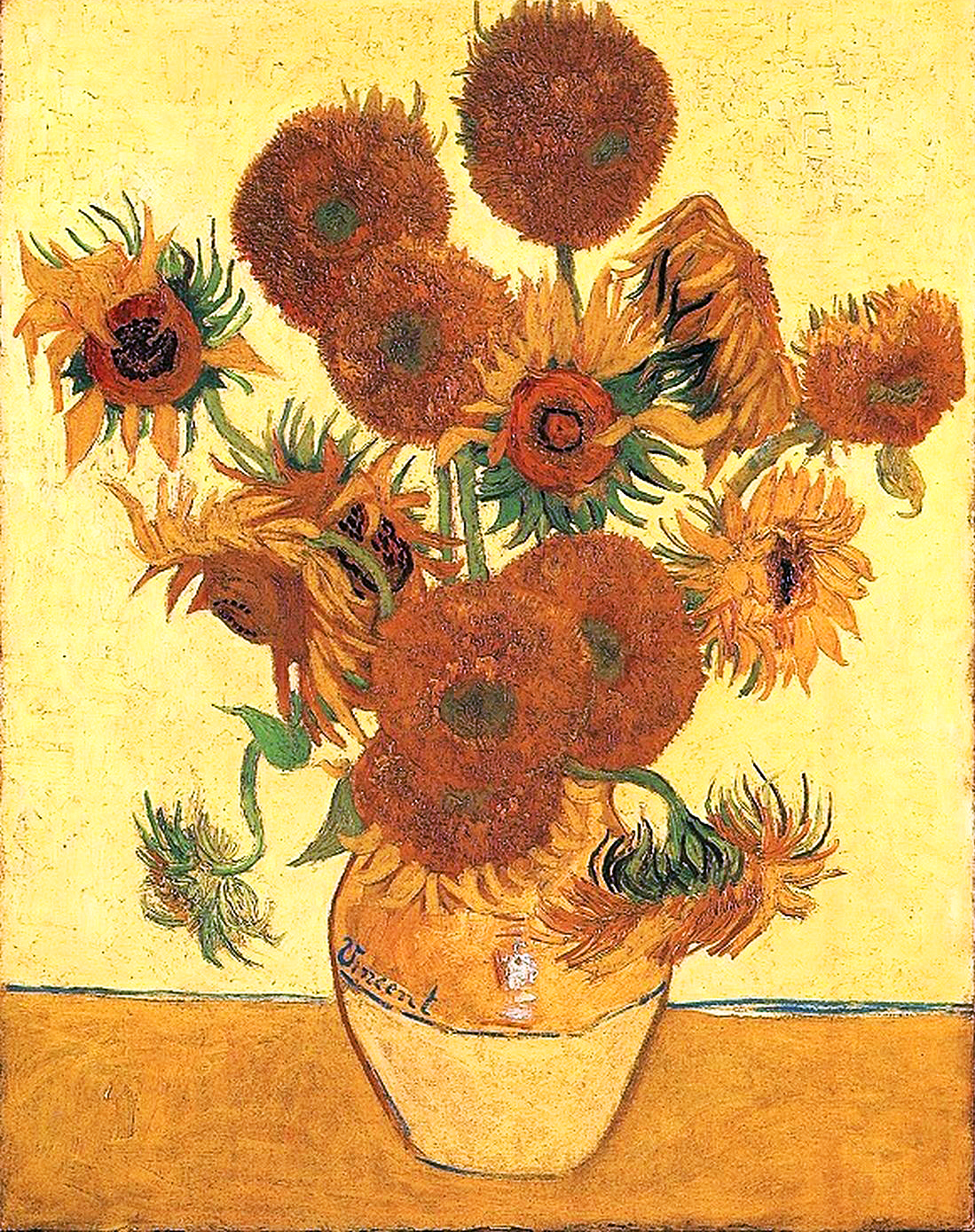
and just for good measure, upstairs, over the fireplace was Vase with Fifteen Sunflowers (1888).


Irises I wasn’t so excited about. What young boy really is; however, especially in summer, I used to look at Wheat Field and could easily imagine being right there — I could smell the wheat and the cypresses carried on a warm breeze. I used to imagine myself at one of the tables in Café Terrace at Night, on the Place du Forum in Arles, just watching the world go by. And Starry Night I could look at for hours — as though in a dream courtesy of Vincent. I found myself wanting to go to the Lapin Agile of Utrillo’s painting, and wanted to go inside, even though I had no idea what a lapin agile was or what the actual place was. I could imagine people walking past the wine and liquor store in his Montmartre, wondered what the church at the top of the butte in Sacre-Coeur de Montmartre was like inside, and wished I could go into the boulangerie in Street in Paris — I could almost smell the bread baking.
It was at about that same time that I became acquainted with Henri de Toulouse-Lautrec via John Houston’s 1952 production of Moulin Rouge with José Ferrer as Lautrec. What a marvelous movie; one in which Houston went to great lengths to match the appearance of actors and actresses with the characters of Lautrec’s Montmartre posters and paintings, not to mention the incredible detail paid to the interior shots of the cabarets and bars. His characters came alive and I was enthralled by their exoticism.


So one might say that in a sense I grew up in Montmartre, at least the Montmartre of the time of Van Gogh, Utrillo, Degas, and so many other artists, as well as the Montmartre of the Chat Noir, the Moulin Galette, and the Moulin Rouge. Montmartre was art, it was music, and was home to so many famous and some notorious folk that stirred the imagination. I went there once. Some visitors to France prefer the Louvre, or Versailles, or the Riviera, but not I. Montmartre was art and life at its grittiest, even then. I could almost hear the ghosts; for it was both wonderful and ghostly all at once. Truth be told, if I were to live in Paris, I would most certainly have to live in Montmartre — no other place would do.
There is a lot more to Montmartre than the average person realizes in terms of its history, art, music, and people. I made the district a sort of hobby and have studied it off and on through the decades, and I hope over the next few weeks to share some of what I have learned about this wonderful, ghostly, sinister and strange place.

Tuesday, May 17, 2016

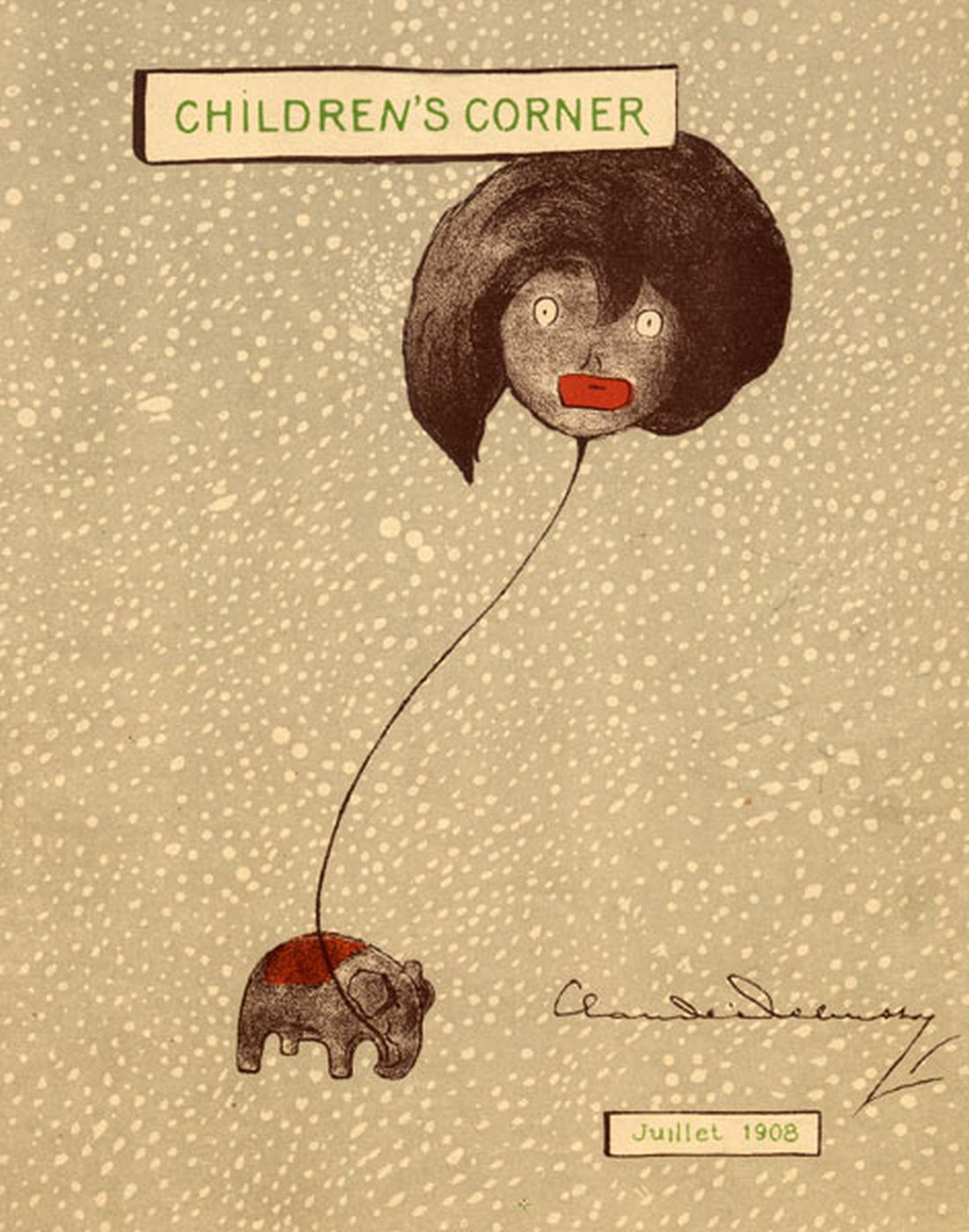
CHILDREN’S CORNER by CLAUDE DEBUSSY

CHILDREN’S CORNER by CLAUDE DEBUSSY


Children’s Corner, a six movement suite for solo piano by Claude Debussy is my favorite composition for or about children next to Camille Saint-Saens’ Le Carnaval des animaux (Carnival of the Animals) which I will explore here at a later date. It was first published by Durand (Paris) in 1908 and premiered there, played by English pianist Harold Bauer, on December 18th of that year. Three years later, an orchestration of Children’s Corner by Debussy’s friend Andre Caplet made its premier.


The work is dedicated to Debussy’s young daughter, Claude-Emma, affectionately known to her father as “Chou-chou” who was only three years of age when it was written. Contrary to popular belief, the suite was not intended to be played by children but rather it was intended to be reminiscent of the pleasures of childhood as well as (interestingly) some of “Chou-chou’s” toys. She was born on October 30 of 1905 and has been described by those who knew her as “lively,” “friendly,” and as a little girl who was adored by her father — something one might not be inclined to expect about the otherwise tempestuous composer. But alas, she died of diphtheria on July 14, 1919, just one year after the passing of her father.


As I mentioned, there are six movements (short pieces really) to the suite, all titled in English; something which Debussy did in acknowledgement of “Chou-chou’s” British governess (and thus no French title for the suite itself). The pieces are in order:

Doctor Gradus ad Parnassum
Jimbo’s Lullaby
Serenade for the Doll
The Snow is Dancing
The Little Shepherd
Golliwogg’s Cakewalk My favorite of the six.)

DOCTOR GRADUS AD PARNASSUM
The title of this piece suggests “Gradus ad Parnassum” (Steps to Parnassus” by Johann Joseph Fux (1660 – 1741), the first counterpoint text in any modern sense of the term and one of the greatest school texts in European music up until that time and Muzio Clementi’s “Gradus ad Parnassum” which is still used. Debussy’s piece is a study in finger independence; where, especially in the middle, the pianist slows down and tries various keys. It is somewhat difficult to play unless one’s fingers are quite skillful and gets wilder toward the end.

JIMBO’S LULLABY
Actually it should be “Jumbo” but French pronunciation sometimes confuses “um” with “un” and with “im” and “in.” Be that as it may, Jimbo was an elephant who lived briefly in the Jardin des Plantes in Paris around time Debussy was born. As a reminiscence of his childhood, it is a wonderful lullaby but with some dark moments.

SERENADE OF THE DOLL
Noted to be played moderately fast…but not too fast (Allegretto ma non troppo) and played with the soft peddle throughout, the piece describes an Asian porcelain doll, probably Chinese, and features the Chinese pentatonic scale.

THE SNOW IS DANCING
A difficult piece with the melody being carried by both left and right hands. Somewhat dark at times, particularly in the middle, it depicts falling snow and faint objects seen through it.

THE LITTLE SHEPHERD

Simple enough, this piece represents a shepherd with his flute — actually three solos and “commentaries” after them, with a lot of dissonance.


GOLLIWOGG’S CAKEWALK
At the time of its composition, Golliwogs were all the rage, due in part to the popularity of the novels of Florence Kate Upton. They were stuffed, black dolls with red paints, red bow ties, and wild hair. This is ostensibly a ragtime piece (also quite popular at the time) with syncopations, a large dynamic range, and various effects. Listen carefully for occasional interruptions by the love-death motif of Wagner’s Tristan und Isolde followed by imitations of a banjo. A “cakewalk” itself was a dance or actually more of a strut often seen in dance competitions of the time in which the dancer with the most elaborate steps one a cake — hence the phrase “took the cake.”

Piano Version:


Orchestral Version:


Sunday, May 8, 2016

JOHN SINGER SARGENT OR THE MAN WHO PAINTED “MADAME X”

John Singer Sargent or The Man Who Painted “Madame X”

In a brief discussion the other day about the Salon de Paris, I happened to mention the name John Singer Sargent and an 1884 scandal involving a “Madame X.” A short while after that, I realized that I really didn’t know much about Mr. Sargent or his art and decided to learn a bit more. I thought I would share what I found with you.


John Singer Sargent (January 12, 1856 – April 14, 1925) was an American artist who was regarded as the leading portrait artist of his time, particularly for his portrayals of Edwardian luxury. Over nine hundred oil paintings and more than two thousand watercolors, as well as a myriad of sketches and charcoal drawings were produced during his artistic career — sizeable by anyone’s standard. From the start, his work was characterized by a remarkable technical facility; in particular, his ability to draw using a brush. His work was in keeping with the accepted (and somewhat restrictive) manner of rendering portraits at the time but later in life he moved away from those limitations and devoted much of his time to creating murals and working en plein air.
His father, FitzWilliam was a successful eye surgeon in Philadelphia; however, when John’s older sister died at the age of two and his mother suffered a breakdown, the couple decided to leave the tragedy behind went abroad. Although their stated home became Paris, the couple moved around Europe following the seasons — a rather nomadic life that took them all around France, to Germany, Italy, and Switzerland. John was actually born in Florence, Tuscany. For the rest of their lives, the couple, two well-off vagabonds living on an inheritance and savings, led a quiet life, generally avoiding European society and Americans, except for friends from the world of art.
At the young age of thirteen, John’s mother noted that her son “sketches quite nicely and has a remarkably quick and correct eye. If we could afford to give him really good lessons, he would soon be quite a little artist.” It was in that same year that the boy did in fact receive some watercolor lessons from one Carl Welsch, a German landscape painter. Not only did he show talent as an artist but he was also quite literate and worldly, with more than a little knowledge of music and literature, as well as a fluency in French, Italian, and German. By age seventeen, John was described as “willful, curious, determined and strong.” It is also said that he was shy, generous and modest. As a budding artist, he was familiar with many of the masters from first-hand observation. As he said in 1874, “I have learned in Venice to admire Tintoretto immensely and to consider him perhaps only second to Michelangelo and Titan.”
John attended the Academy of Florence but things did not go well, primarily because the school was in the process of reorganization; so it was back to Paris where he studied with Carolus Duran, a young, extremely popular portrait artist noted for both bold artistic techniques and his modern methods of teaching. Later that year, John passed the arduous examination which was required to gain admission to the École des Beaux-Arts, the premier art school in France, where he studied drawing — classes that also included both anatomy and perspective. He also spent much of his time practicing drawing in museums as well as in a studio which he shared with James Carroll Beckwith [(September 23, 1852 – October 24, 1917), an American landscape, portrait and genre painter whose Naturalist style led to his recognition in the late nineteenth and very early twentieth century as a respected figure in American art.] and additional lessons from Léon Bonnat.
As noted, Duran was a progressive and dispensed with traditional academic approaches to art, approaches which required careful drawing and underpainting. Duran taught the alla prima method working directly on a canvas with a loaded brush, relying on proper placement of tones of paint. This same method allowed for spontaneous flourishes of color which were not dependent on any under-drawing. Sargent took to this approach like a duck takes to water. As Julian Alden Weir noted, Sargent was “one of the most talented fellows I have ever come across; his drawings are like the old masters and his color is equally fine.” John was both popular and admired and it was through a friendship with Paul César Helleu, that he was able to meet some of the greats of his time, such as Degas, Rodin, Monet, and even Whistler.

Fanny Watts (1877)

Although Sargent was most enthusiastic over landscapes and not portraiture, Duran finally influenced him to follow that path; portraits being perhaps the best way to promote one’s art career and exhibiting in the Salon — not to mention gaining commissions and thus a livelihood. His first major portrait was of a friend, Fanny Watts, in 1877 which was also his first work exhibited at the Salon — immediately drawing the attention of public and judges alike. His second submission to the Salon was “Oyster Gatherers of Cancale,” a painting in an impressionistic style. He made two copies of this painting and sent one to the United States — both received more than favorable reviews.
In 1879 Sargent produced a portrait of Duran which met with wide public approval at the Salon and marked the path that his mature work would follow. American writer Henry James wrote of Sargent that the artist offered “the slightly uncanny spectacle of a talent which on the very threshold of its career has nothing more to learn.” Sargent then left Duran’s tutelage and traveled to Spain where he studied the painting techniques of Velazques and where he obtained ideas for future works. He also found himself captivated by Spanish music and dance, reawakening his own talent for music and providing the visual expression found in his work “El Jaleo” (1882). From that point on, music and not just painting played a significant part in his social life and as an accompanist to various amateur and professional musicians, as well becoming an advocate of contemporary composers such as Gabriel Fauré.

"El Jaleo" (1882)

After Spain he went to Italy and then returned to Paris where he received numerous commissions for portraits, and his career was thus firmly established, giving him both fame and the ability to pick and choose who sat for him, and to very set high prices. He worked with a high degree of stamina and concentration, almost workman-like, which became one of his trademarks for the next quarter of a century.
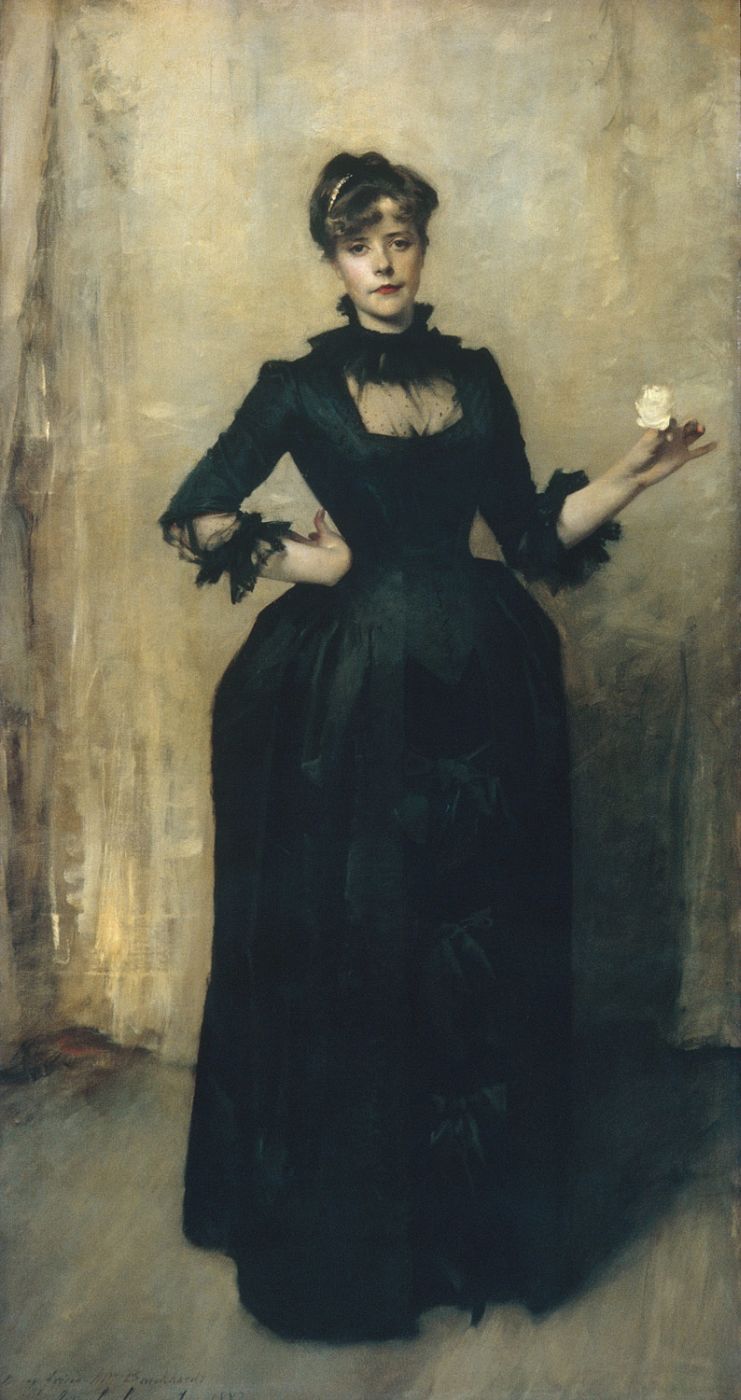
The best of Sargent’s portraits show the distinct individuality and personality of the sitters, perhaps only matched at the time by Velazques, as seen in “The Daughters of Edward Darley Boit” (1882). One of his most exhibited portraits of that period was “The Lady with the Rose” (1882) – a portrait of Charlotte Burckhardt who was both a close friend of Sargent’s and a possible romantic interest as well.

"The Daughters of Edward Darley Boit" (1882)

"The Lady with the Rose" (1882)

It’s interesting how things turn out sometimes — Sargent’s most controversial work, “Portrait of Madame X” a portrait of Madame Pierre Gautreau rendered in 1884, was his most controversial work and now is regarded as one of his best, not to mention the artist’s own personal favorite: “I suppose it is the best thing I have ever done.” When it was first unveiled at the 1984 Salon, it stirred such a negative reaction that it drove Sargent to move London. His self-confidence had led him to attempt an experiment in portraiture which seemed to backfire. The portrait had not been commissioned by her; but instead, he had pursued her for a chance to paint the lady. He wrote to a mutual friend somewhat egotistically, “I have a great desire to paint her portrait and have reason to think that she would allow it and is waiting for someone to propose this homage to her beauty…you might tell her that I am a man of prodigious talent.”
When she at last agreed, it took Sargent over a year to complete the painting, whose first version portrayed a now famous plunging neckline, white-powdered skin, an arrogantly cocked head, and an off-the shoulder dress strap which gave a daring and sensual effect. Ultimately Sargent changed the strap to assuage some of the controversy but — too late! Almost as quickly as lightning, his French commissions ceased. Gravely disappointed, he even contemplated giving up painting for a second career in music. French poet and historical novelist Judith Gautier, the daughter of Théophile Gautier, wrote of the exhibition of “Madame X”: “Is it a woman? A chimera (a monstrous fire-breathing hybrid creature of Lycia in Asia Minor, composed of the parts of more than one animal), the figure of a unicorn rearing as on a heraldic coat of arms, or perhaps the work of some oriental decorative artist to whom the human form is forbidden and who, wishing to be reminded of woman, has drown the delicious arabesque? No, it is none of these things, but rather the precise image of a modern woman scrupulously drawn by a painter who is a master of his art.”


Prior to the “Madame X” scandal, Sargent had painted exotic beauties such as Rosina Ferrara of Capri and Spanish model Carmela Bertagna, but those had never been widely exhibited in public. As for “Madame X,” he kept “her” prominently displayed in his London Studio until it was sold to the Metropolitan Museum of Art in 1916.


English critics were at first rather cold to Sargent, citing his “clever Frenchified” techniques; one reviewer calling his technique “hard” and “almost metallic” with “no taste in expression, air or modelling.” Eventually, with the help of that same critic, he began to gain English admiration.
By 1900 Sargent was at his peak of fame. Although still only in his forties, he began to travel more and to devote less time to painting. In 1907, at the age of fifty-one, he officially closed his studio, stating “Painting a portrait would be quite amusing if one were not forced to talk while working…What a nuisance having to entertain the sitter and to look happy when one feels wretched. In that same year, he also painted his own modest, serious self-portrait — his last portrait. Instead, he pursued architectural and landscape subjects.


As Sargent wearied of portraiture he pursued architectural and landscapes subjects instead; however, his fame remained remarkable — he even turned down a knighthood. He made numerous visits to the United States including an extended stay form 1915 until 1917, during which he produced some very grand portraits, including one of John D. Rockefeller. But not so soon later, Sargent found himself relegated more and more to the category of a “master of the past.” Modernism was in and trends such as Cubism and Futurism pushed him aside

In 1922 Sargent co-founded New York City's Grand Central Art Galleries along with Edmund Greacen and Walter Clark, participating in the gallery and its academy until his death in 1925 in England of heart disease.

Sunday, April 17, 2016

ALBERT KETELBEY


I am almost certain that you have heard the man’s music, but probably never heard his name. As I recall, the first time I ever heard one of his most popular pieces was when I was seven years old, at a dance recital in which my cousin Dianne was a participant. The melody stuck with me and since then I have often (and fondly) listened to it, primarily as a band piece played by some municipal band, such as the San Francisco Municipal Band at their Golden Gate Park summer concerts. However now that I think about it, I hadn’t heard it for some years; yet, the melody immediately popped into my head when I saw that the now Golden Gate Park Band had announced its 2016 schedule. The melody was that of In a Persian Market and the composer was Albert Ketelbey (August 9, 1875 – November 26, 1959)


A composer, conductor, and pianist, he was born in Birmingham, England and moved to London in 1889 where he studied at the Trinity College of Music, and where his abilities set him far apart from his classmates. After graduation however, he surprised almost everyone by pursuing work not in classical music but as the musical director of the Vaudeville Theater. Ultimately he gained fame as the composer of some of England’s most favorite light music, what could have been considered “pop tunes” of the day, and as a conductor of his own works.


He also worked for many years for several music publishers such as the Columbia Graphophone Company, as an arranger and orchestrator, and later wrote music for silent films. While his pieces in the orthodox classical style of the day were often widely appreciated, it was his light orchestral pieces that made him famous. One of his earliest pieces, In a Monastery Garden (1915) actually sold over a million copies and brought him considerable notoriety. He followed this with In a Persian Market (1920), Cockney Suite (1924), In the Mystic Land of Egypt (1931), and In a Chinese Temple Garden (1932) — best sellers all, both in print and on records, which made him a millionaire. (See Below)


It was during World War II that his popularity began to decline along with his originality; indeed, much of his post-war works were actually reworked versions of older pieces. Ultimately he retired, in 1949, to the Isle of Wight where he remained until his passing.


In a Monastery Garden


In a Chinese Temple Garden


In the Mystic Land of Egypt

A VERY BRIEF HISTORY OF THE SALON DE PARIS


The Salon (or more formally the Salon de Paris), with roots extending as far back as 1667, was the official exhibition of art by the Académie des Baux-Arts. In the years between 1748 and 1890 the Salon de Paris without doubt, staged the greatest art events held in the western world. In 1667, the Académie Royale de Peinture et de Sculpture, part of the Académie des Baux-Arts, held its first art exhibition at the Salon Carré, with its focus on the works of recent graduates of the École des Baux-Arts. In short order, to have one’s work shown at the Salon de Paris was considered vital in order for any artist to achieve even a modicum of success in France and it remained so for the next two hundred years.

Salon de Louvre, 1737.

In the year 1725, the Salon was held in the Palace of the Louvre and received its name, Salon or Salon de Paris. While up until that time exhibitions had been regarded only as more or less private, beginning with the 1737 exhibition in the Grand Salon, they indeed became fully public (within limitations), and were held annually; and later, biennially in odd-numbered years. Beginning in 1748, the task of judging the exhibitions was given to a jury of award-wining artists, thus establishing the Salon’s preeminence over French art.

Honoré Daumier 'Free day at the Salon' From the series "Le
Public du Salon," published in Le Charivari (May 17, 1852)

By modern standards, the exhibitions of art at the Salon were what could well be termed, “chaotic magnificence,” with paintings hung floor-to-ceiling, utilizing every inch of space possible — far removed from today’s orderly, moderated gallery exhibitions. At the same time, for good or bad, critical accounts of the exhibitions were published in the local newspapers and journals, giving birth to the (still) dreaded art critic.

 
The Salon, 1865

The Salon, 1866

While attendance to the earlier, royal-sanctioned art exhibits had been limited to the aristocracy and “upper-classes” and exhibitors limited solely to French artists, the French revolution, in keeping with the motto of “Liberté, égalité, fraternité,” opened the exhibitions up to not only foreign artists as well as French, but to the public, or at least to those who could afford tickets; and opening night became a grand social event. After the 1848 revolution, the number of refused works grew less and less and the practice of awarding medals was instituted.
As time passed however, the Salon jurors became increasingly conservative and as Impressionism began to gain in prominence in some art circles, Impressionist artists found themselves either rejected with increased frequency or that at the very least, their works were placed in obscure locations — all because their style was a decided turn away from accepted, traditional painting styles. An unusually high number of submissions were turned away in 1863, resulting in a furor which included artists who had up to that time been regular exhibitors but found themselves excluded. In response, as though somehow to prove that the Salons were in fact “democratic,” Napoleon III began the Salon des Refusés, literally the “exhibition of rejects,” which opened in May of 1863, simultaneously marking the advent of the avant-garde. Ultimately, the Impressionists held their own series of independent expositions in 1874, 1876, 1877, 1880 – 1882, and in 1886. The French government however, which had historically sponsored the annual Salon exhibitions, withdrew its sponsorship, with the Société des Artistes Francais, stepping in.

The Salon, 1890.

In 1890, the Société suggested to the French art community that the Salon should be limited to an exhibition by young artists who had not previously won awards. This idea went over like a lead Montgolfier balloon, particularly with such “senior” artists as Auguste Rodin and his colleagues, who then broke away to form their own Société Nationale des Beaux-Arts, and it was the Société that began its own exhibition, the Salon du Chap de Mars or more properly the Salon de la Société Nationale des Beaux-Arts, chaired by Théophile Gautier. Dissatisfaction continued on into the next century when in 1903 a group of artists led by Pierre-Auguste Renoir, Henri Matisse and Auguste Rodin formed the Salon d’Automne (Autumn Salon), which became the showcase for development and art innovation in the early 20th century, further establishing the eminence of Rodin, Renoir, Cezanne, and Gaugin among others.

The Salon, 1932.